La estela de Merneptah
Un pueblo llamado Israel existía en Canaán hacia el 1208 a. C., nombrado por un rey egipcio hostil que no tenía interés alguno en halagarlo.
Nombrado fuera de la BibliaInscripciónc. 1208 BC
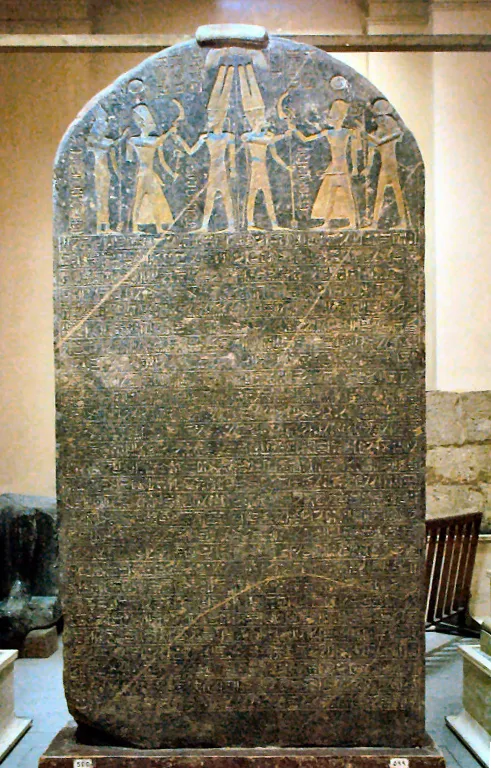
A black granite victory stele of the pharaoh Merneptah. Its closing lines list places and peoples defeated in Canaan — Ashkelon, Gezer, Yanoam — and among them "Israel", written with the hieroglyphic marker for a people rather than a settled city-state. It is the earliest known mention of Israel anywhere outside the Bible.
Israel is laid waste, his seed is not.
- Hallado
- Merneptah's mortuary temple, Thebes, Egypt, 1896 — W. M. Flinders Petrie
- Se conserva en
- Egyptian Museum, Cairo (JE 31408)
- Lengua
- Egyptian (hieroglyphic)
- Cómo llegó hasta nosotros
- Excavado, o todavía en pie donde se construyó.
Qué muestra
The reading "Israel" is near-universally accepted. What the stele does not tell us is Israel's size, origin or organisation; those remain debated.
Cómo lo usan los historiadores
Standard fixed point in the archaeology of Late Bronze Age Canaan, cited in secular handbooks as the terminus ante quem for Israel's presence in the land.
En la Escritura
Se relaciona con
Fuentes
Por ahora estos textos están en inglés. Las traducciones llegarán.