El prisma de Senaquerib: Ezequías encerrado «como pájaro en una jaula»
La invasión de Judá en el 701 a. C., Ezequías por su nombre, el asedio de Jerusalén y el tributo están registrados por el propio invasor, y la supervivencia de la ciudad se deduce de su silencio sobre haberla tomado.
Nombrado fuera de la BibliaInscripciónc. 691 BC
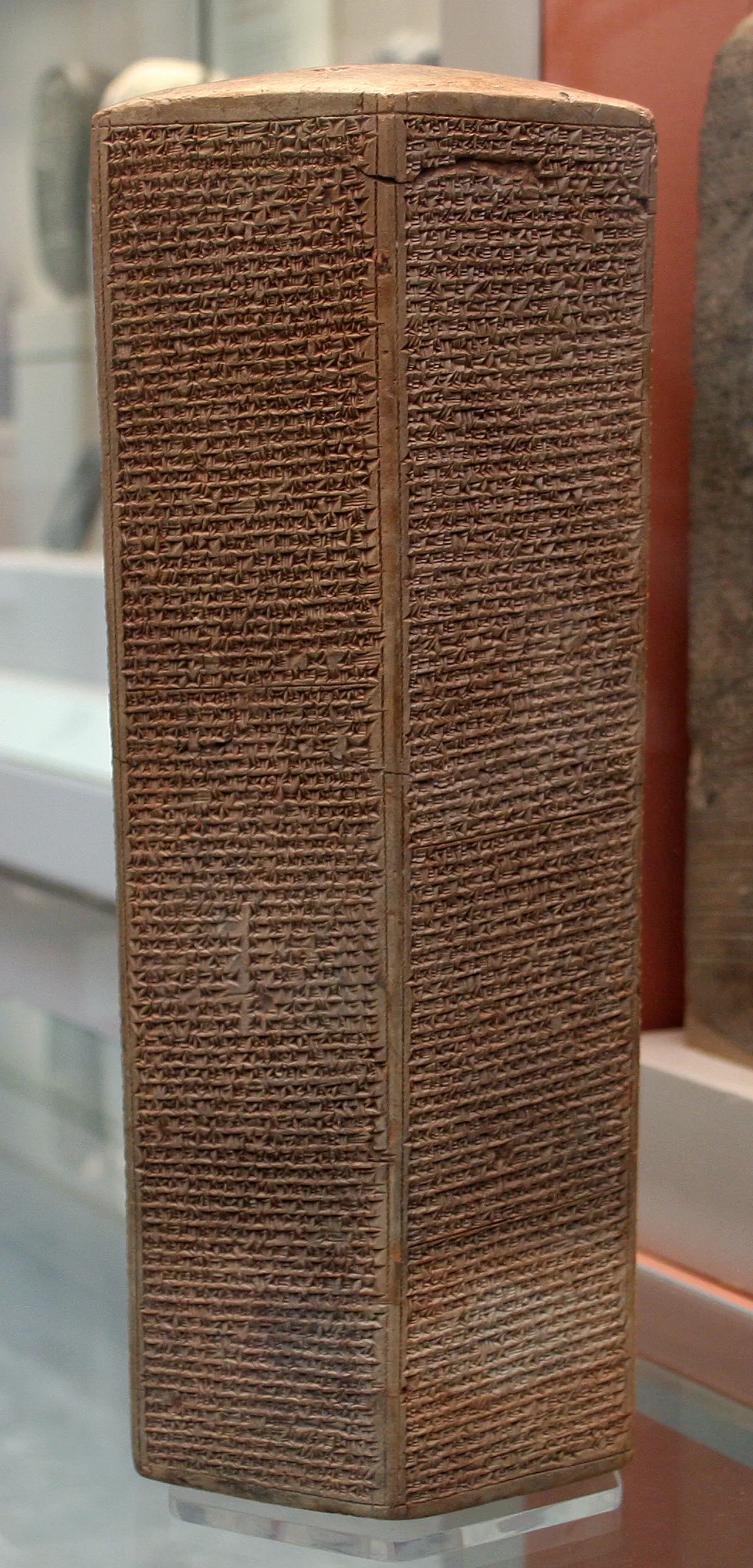
A six-sided clay prism recording Sennacherib's campaigns. The third describes his 701 BC invasion of Judah: forty-six walled towns taken, Hezekiah besieged in Jerusalem, heavy tribute exacted. What the Assyrian account conspicuously does not claim is the capture of Jerusalem — the one city its own annals leave standing.
As for Hezekiah the Judahite, who did not submit to my yoke… him I shut up in Jerusalem his royal city like a bird in a cage.
- Hallado
- Nineveh, Iraq, 1830 — Acquired by Col. R. Taylor, British Consul-General at Baghdad
- Se conserva en
- British Museum, London (near-duplicates in Chicago and Jerusalem) (BM 91032 (Taylor Prism))
- Lengua
- Akkadian
- Cómo llegó hasta nosotros
- Excavado, o todavía en pie donde se construyó.
Qué muestra
Both sides agree on the campaign, the siege and the tribute; they differ on why Sennacherib withdrew. The Assyrian text simply stops short of claiming the city.
Cómo lo usan los historiadores
The 701 BC campaign is one of the best-documented events in Iron Age history, reconstructed by secular historians from the Assyrian annals, the Lachish reliefs and the biblical account together.
En la Escritura
Se relaciona con
Fuentes
Por ahora estos textos están en inglés. Las traducciones llegarán.